

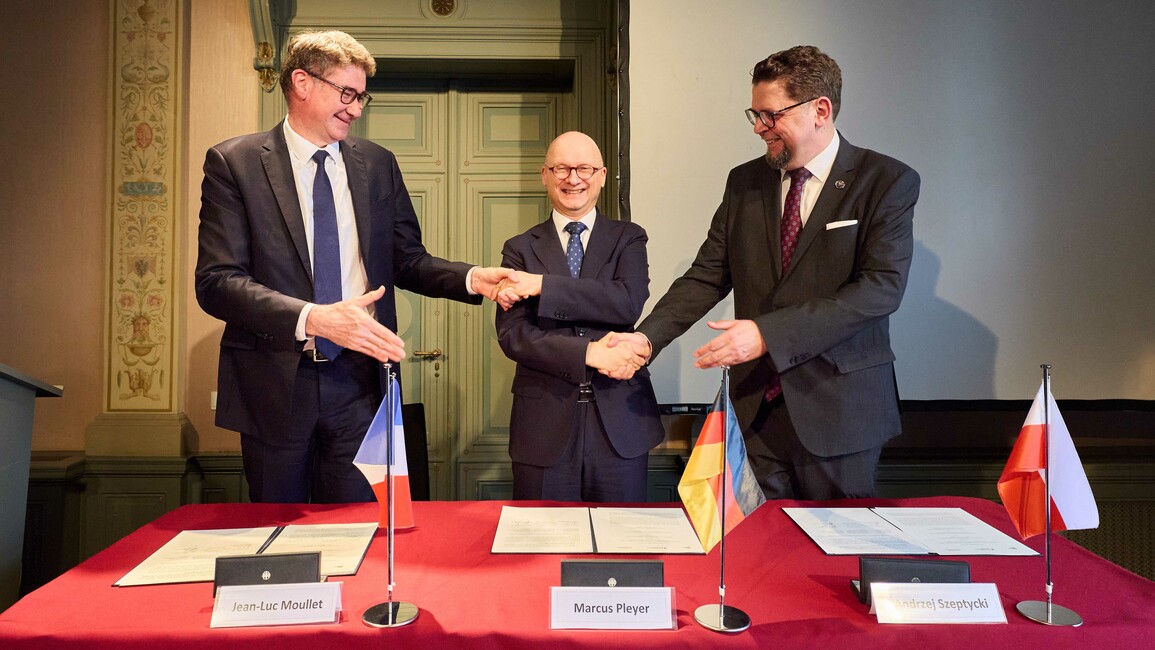
Strengthening cooperation in the Weimar Triangle is a key endeavour under the coalition agreement of the Federal Government. State Secretary Dr. Marcus Pleyer signed the Declaration together with his French and Polish colleagues, the Director General for Research and Innovation Jean-Luc Moullet and Undersecretary of State Professor Andrzej Szeptycki. The signing took place on the occasion of an expert meeting on “Scientific Platforms of the Weimar Triangle – Building European Networks of the Future” and the 35th anniversary of the establishment of the Weimar Triangle.
The Declaration of Intent I signed today together with my colleagues from France and Poland sends a strong signal for researchers in the three countries to intensify their cooperation in joint projects at bilateral, trilateral and European level. It is very important to me that the future-relevant topics of the High-Tech Agenda Germany be included in this cooperation.
Dr. Marcus Pleyer, Staatssekretär im Bundesministerium für Forschung, Technologie und Raumfahrt
Joint Declaration of Intent concerning research cooperation
By signing the Declaration, Germany, France and Poland confirm their intention to further intensify cooperation in research and innovation. They want to
- intensify the dialogue on scientific issues and strengthen the exchange between researchers, research institutions and science organizations;
- examine how proven instruments of bilateral cooperation can be used for trilateral cooperation in the Weimar Triangle;
- encourage researchers from the three countries to further expand their cooperation in European research programmes.
New initiatives for science platforms
The Federal Ministry of Research, Technology and Space (BMFTR) wants to expand the cooperation between the three countries by establishing a joint science platform, thereby strengthening the Paris-Berlin-Warsaw axis. Science platforms provide lasting structures for easier cooperation in research.
Besides signing the Declaration of Intent, the BMFTR has therefore launched a number of measures. These include the development of recommendations for joint science platforms. The aim is to thoroughly analyse fields of cooperation between Germany, France and Poland. The consulting company Prognos AG has been entrusted with this task. The focus is on the secure handling of research data, stronger links between researchers and improved possibilities for joint European funding proposals under the Horizon Europe programme.
In addition, the BMFTR is funding the project “Network for the future – Weimar Triangle: Science for Europe”. The project will be supported with approx. €4.5 million until 2029. It provides individual scholarships for up to 120 doctoral students and postdocs from Germany, France and Poland. Furthermore, it strengthens links between them as well as scientific exchange.
Cooperation with France and Poland
France is Germany’s most important partner in science and research. Researchers from both countries cooperate in fields such as artificial intelligence and IT security and on new forms of energy in battery and hydrogen research. The basis of cooperation is the Treaty of Aachen signed in 2020.
Germany also enjoys close cooperative relations with Poland in education, research and innovation. The German-Polish Science Foundation is an important element. It has been funding joint projects since 2009, mainly in the humanities and the social and economic sciences. Furthermore, cooperation is becoming increasingly important in the areas of digitalization, medical engineering and green technologies.
Textbox
The Weimar Triangle
The Weimar Triangle is a format for political cooperation between Germany, France and Poland. It was established in Weimar on 28 August 1991, when the Foreign Ministers Hans-Dietrich Genscher, Roland Dumas and Krzysztof Skubiszewski met to develop common perspectives for Europe’s future.
The Weimar Triangle has since served as a forum for discussion of major European issues. The aim is to identify common interests and strengthen cooperation between the three countries. This format helps to advance European integration and to address common challenges.